
Four years and two articles apart, the same twenty-four reasons kept pointing at four human conditions —and at the two the boardroom already owns.
This article was originally published in Forbes.
Four years ago I wrote a piece for Forbes called “12 Reasons Your Digital Transformation Will Fail.” The failure rate then was 84%, and not one of the twelve reasons was about technology. Transformation is roughly 80% soft skills and 20% tech. This year I wrote “12 Reasons Artificial Intelligence Will Make You Obsolete” … same reveal, this time at the individual level. I had written the same article twice and not noticed.
Jonathan Streeton, a leadership consultant I work with in the UK, noticed. He distilled the reasons into four conditions and gave them a name: CODE.
Capability — can leadership and people actually do the new thing?
Ownership — is the right leadership holding it, with real authority and accountability?
Direction — is there a defined destination, with an explicit line to business value?
Engagement — do people trust it enough to adopt it, rather than quietly route around it?
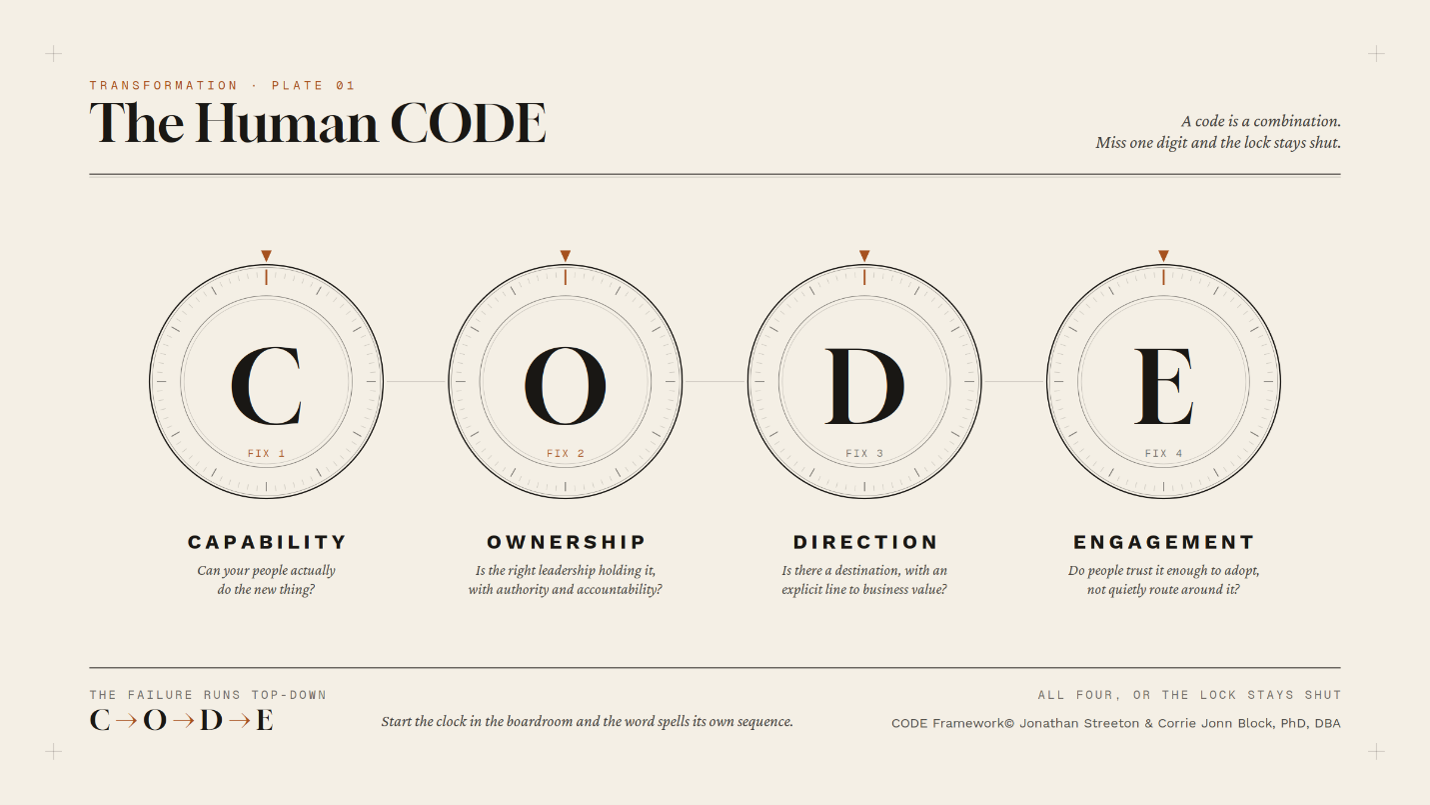
A code is a combination. Miss one digit and the lock stays shut.
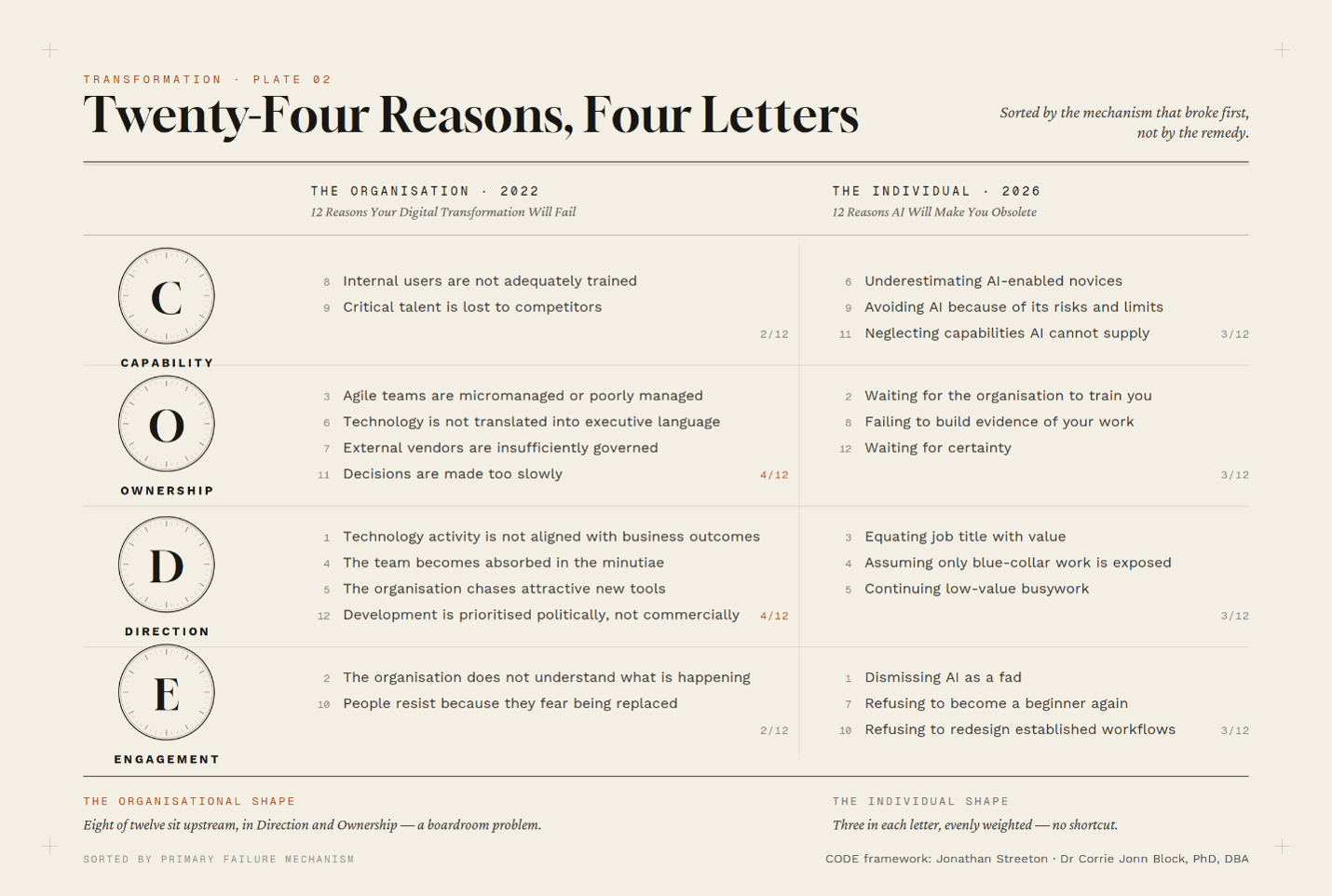
One caveat. Several reasons touch two letters: losing critical talent is a Capability failure, but disengagement usually drove them out. So the sorting rule is critical. Never “which letter could fix this?” Always “which letter broke first?” Get that wrong and you’ll fund a remedy for a problem you don’t have. Which, incidentally, is what most transformation budgets are.
Read the Eight Again
Decisions made too slowly. Technology nobody translates into executive language. Vendors nobody governs. Development prioritised politically. Funding with no line to a business outcome. Not one of these is a workforce behaviour.
Every one is an executive behaviour.
The failure surfaces as Direction and Ownership. It originates in the people who are supposed to set the one and hold the other.
And one layer deeper still. Why do otherwise excellent executives fail at direction and ownership the moment the subject is technology? The 2022 list already held the answer: we promote brilliant technologists into roles that need leaders, and we seat accomplished leaders over technology they have never personally touched.
Both are capability gaps, not the user-training kind, but executive capability: AI fluency, sensemaking, judgement, the leadership of a landscape you can’t yet read. You can’t point at a destination on a map you can’t even read. And you won’t own what you can’t defend in the room. Watch any boardroom: the portfolios executives fight to hold are the ones they understand.
Most change budgets are spent downstream, treating symptoms manufactured upstream.
The Failure Cascade
Crack the CODE at the top of the organisation and the sequence reveals its own failure and fix sequence. Capability breaks first, in the boardroom and the ExCo. Ownership fails next and cascades down the chart: n won’t hold what it can’t defend, so n-1 hedges, so n-2 waits. Direction fragments at mid-management: ask twelve VPs for the destination and you’ll get twelve different headings. And Engagement fails last and everywhere, because engagement is the organisation’s verdict on everything it has watched the top three layers do.
C, then O, then D, then E. You just have to read it from the top of the org chart.
A caveat, because the distinction matters: the sorting shows where failure surfaces, not where it starts. The cascade is an inference. But it’s an inference with two witnesses. The first is the money. MIT’s Project NANDA found that of some $30–40 billion poured into enterprise generative AI, roughly 95% of pilots produced no measurable P&L impact: a contested figure the authors call directional, but the mechanism isn’t disputed: the divide is driven by approach, not models.
84% then. 95% now. New technology, same four letters. Same burnt budget.
The second witness is the other list. The obsolescence twelve sort into the same four letters, three in each: a personal CODE. Hold it against the organisational list and the pairs line up: an executive waiting for certainty becomes an organisation deciding too slowly; a leader who refuses to be a beginner becomes a technology nobody at the top has touched. Which is the proposition I’d put in front of any board: an organisation can’t score higher on the CODE than its leaders score personally. In a technology shift, the leaders’ first digit is Capability.
Humans are the problem. And the solution.
The Fix Cascade
If the failure route runs top-down, so does the repair. The same four letters, the same order.
Fix executive capability first. Not a briefing deck; hands on the tools. A chief executive who has redesigned their own workflow around AI, made beginner’s mistakes in front of the team and kept going has done more for the transformation than any town hall. Ownership follows, because competent leaders claim what they can defend, and each layer holds what it watches the layer above it hold. Direction then reaches mid-management in one sentence instead of twelve. And Engagement stops being a campaign, because it was never a communications product. Engagement is a byproduct of modelled Capability, visible Ownership and consistent Direction.
One warning on that word byproduct: it doesn’t mean automatic. You still owe people the honest answer to what changes, what stays and what happens to them.
Four Questions, In Order
For your next executive meeting.
Capability: when did the people in this room last spend a full working day inside the tools we’re asking ten thousand people to adopt?
Ownership: who holds the outcome at n-1 and n-2, by name?
Direction: would every leader at this table describe the destination in the same sentence?
Engagement: have we told people honestly what changes, what stays, and what happens to them?
I spent four years writing twenty-four reasons transformations fail. It took someone else’s four letter CODE to show me they were four reasons all along, asked twice: once of the organisation, and once of the person running it.
The first digit is under your own hand.
So: can the people at the top transform themselves? Because until that answer is yes, nothing below them will transform either. I’m 95% certain.
References
Block, C. J. (2022, March 16). 12 reasons your digital transformation will fail. Forbes Coaches Council. https://www.forbes.com/councils/forbescoachescouncil/2022/03/16/12-reasons-your-digital-transformation-will-fail/
Block, C. J. (2026, April 3). 12 reasons artificial intelligence will make you obsolete. Forbes Coaches Council. https://www.forbes.com/councils/forbescoachescouncil/2026/04/03/12-reasons-artificial-intelligence-will-make-you-obsolete/
Challapally, A., et al. (2025, July). The GenAI divide: State of AI in business 2025. MIT Project NANDA. https://mlq.ai/media/quarterly_decks/v0.1_State_of_AI_in_Business_2025_Report.pdf
Further coverage of the contested 95% figure: Marketing AI Institute, CloudFactory, Yahoo Finance and Forbes (Snyder).