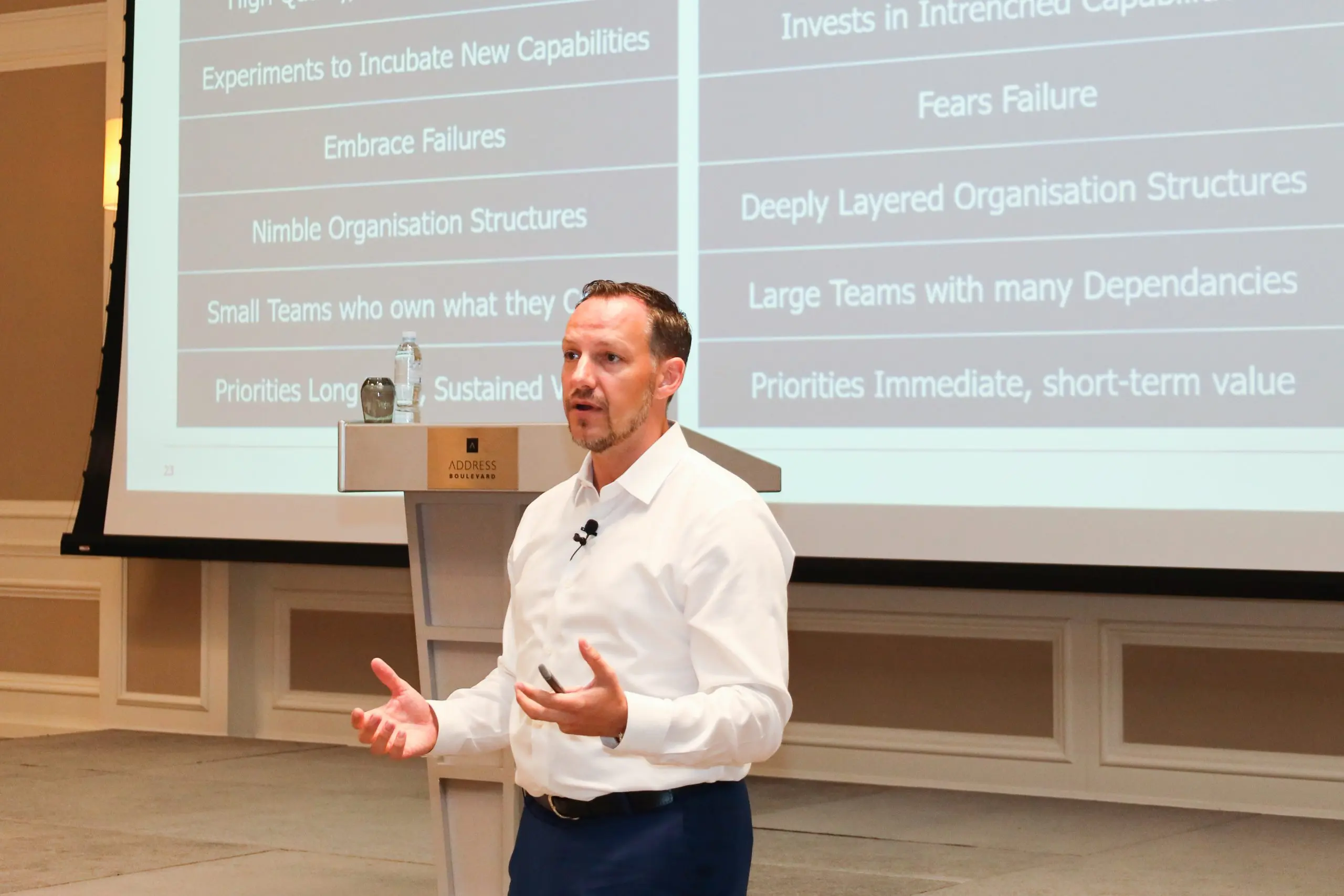
Dr. Corrie Block is a Tier-1 Executive Performance & Neuroscience Coach, Amazon #1 Bestselling Author and 3xTEDˣSpeaker, based in Dubai, UAE.
As of early 2024, the International Monetary Fund estimated that almost 40% of global employment is exposed to AI, and in advanced economies, it’s about 60%. If you’re reading this from a nice office, a Zoom-safe background or a business-class lounge, you are not “safe.”
In fact, you’re expensive. (And maybe expendable.)
Now, let’s be clear about something: Exposure isn’t destiny. But it is a forecast. And ignoring a forecast during a major storm is … well, stupid.
The AI Forecast—Why You Should Worry
As early as 2023, OpenAI researchers estimated “that around 80% of the U.S. workforce could have at least 10% of their work tasks affected by the introduction of LLMs,” and roughly 19% could see at least half their tasks impacted. That’s not the “future of work.” That’s this decade’s work. Your work.
A senior leader I coach recently said, “I’m not worried about AI; my job is strategic.” Two weeks later, she watched a junior teammate use an AI assistant to draft, iterate and sharpen a board-ready brief in an afternoon. Same brain. Same business context. Different toolbelt. She wasn’t replaced by AI, but she was outpaced by a youngster who bothered to play with it.
Another executive coaching client of mine watched in horror as I created, trained, tested and deployed an AI agent to replace his CXO role in less than an hour during our coaching session. That was the wakeup call he needed to start augmenting himself as a part of our intervention.
The horse industry didn’t die the day the Model T appeared in 1908. It died in the years after people realized the machine was cheaper, faster and good enough; by 1960 there were only 3 million working farm animals in the U.S., down from a peak of 20.7 million in 1923.
Yesterday’s cars eliminated horses; today’s cars are eliminating drivers.
Yesterday’s software eliminated accounting; today’s AI is eliminating accountants.
Get it? (Hint: You might be the horse in this scenario.)
McKinsey estimates that current generative AI could automate activities that consume 60% to 70% of employees’ time and “could add the equivalent of $2.6 trillion to $4.4 trillion annually across the 63 use cases they analyzed.” So, if you feel a little concerned right now … good! Fear is data.
Your job is probably in the machine’s digital crosshairs. The question is: What will you do now?
As skydivers say: The only thing that will definitely kill you is panic. (Insert five rounds of five-second box breathing here.)
12 Reasons AI Will Make You Obsolete
1. You treat AI like a fad.
Cynicism is the laziest form of intelligence. “This is just hype” is what people say right before they get overtaken by the people who didn’t need certainty to start learning.
2. You’re waiting for your company to train you.
When did professional development become something you outsource to HR? If your employability depends on a quarterly workshop, you’ve already lost the race.
3. You think your job title is your value.
AI won’t replace “managers” or “analysts.” It replaces tasks. If you can’t translate your role into a stack of tasks, you can’t defend your relevance.
4. You assume displacement is only a blue-collar problem.
Automation has always been about task reallocation, not job labels, and it has real wage and career consequences. White-collar immunity is a comforting myth.
5. You keep doing ‘busywork’ because it feels productive.
Slide polishing. Status updates. Meeting notes. Congrats on your artisanal administrative labor! AI is already eating that buffet.
6. You underestimate how fast novices can catch you.
In a large field study, access to a generative-AI assistant increased productivity by about 14% on average, with much larger gains for novice and lower-skilled workers. Translation: AI compresses the advantage of experience.
7. You refuse to become a beginner again.
Most professionals aren’t afraid of AI itself; they’re afraid of looking incompetent in public. Pride is a career tax.
8. You don’t build ‘proof of work.’
In the AI era, your CV matters less than your portfolio. Can you show workflows, decisions and outcomes? If not, you’re asking people to trust you on vibes.
9. You never learn the limits (and risks), so you avoid the tool.
Yes, AI hallucinates. Yes, it can leak data. Yes, it can be wrong with alarming confidence. That’s precisely why competent professionals learn verification and safe use tactics. Avoidance is abdication.
10. You refuse to redesign your workflow.
AI isn’t a magic wand you wave over your existing habits. It’s a power tool. If you hold it like a hammer, you’ll blame the tool for your bruised thumb.
11. You don’t invest in the skills AI can’t donate to you.
AI can draft, summarize and generate. It cannot give you courage, integrity or accountability. The future belongs to people who can lead, influence and ship under uncertainty.
12. You wait for certainty.
The World Economic Forum reports that 39% of key skills are expected to change by 2030. “I’ll start when it’s clearer” is another way of saying, “I’ll start running when the race is over.”
The Reveal
None of these reasons is about model sizes, GPU clusters or the latest shiny agentic stack. They’re about doubt, cynicism, apathy and laziness, the four horsemen of the AI apocalypse, dressed up in professional language.
AI will not make you obsolete.
Your refusal to adapt will.
And yes, a person using AI will outcompete a person who won’t.
Your One-Week Anti-Obsolescence Protocol
If you want a practical starting point, do this for one week:
Monday: Audit your task list. Mark what is repetitive, document-heavy or template-driven.
Tuesday: Build one AI-assisted workflow for a real deliverable (email, brief, analysis, proposal). Measure time saved and quality improved.
Friday: Publish your “proof of work” internally: what you did, what changed, what you learned and what you will do next.
Final Thoughts
Curiosity, competence and courage—in that order.
Someone is learning to do your job right now with AI as their learning and delivery accelerant. They’re not coming up behind you; they’re already in front of you.
If someone gave your competitor your brain plus AI, what part of your job would still be uniquely yours?